I left you so suddenly last week, having only written about 3 wines that recently passed through my lips.
Well, I've got some more for you. God, I wish I could've taken these home. A few were merely solid deals. Some were absolute classics.
Here we go...
Marcel Deiss Pinot Blanc, Burgheim, Alsace, France, 2005: 8.2
Alsace is that tiny region in northeastern France, that along with Lorraine (as in the cheese) were involved in a not-so-lovely literal game of tug-of-war. Once part of Germany, now France, the culture is truly somewhere in between (or some might say realistically not truly part of either).
I noticed a pretty cashew/almond nose to the wine, leading into a nutty, mineral-rich wine. This was a fruit-neutral wine, with a mere touch of sweetness. There is no domination here, rather a kind of velvety expression. Definitely a good sushi wine. ($25-30)
Pairs with "Joga" by Bjork.
Schiopetto Pinot Bianco, Collio Goriziano, Friuli, Italy, 2004: 8.8
I love Northern Italy. This clinches it. There is so much diversity in that section of the world. From joyful juiciness, to legendary elegance. Simple wines here even have a way of feeling unique and exciting.
What a friggin' oddball, in comparison to what we usually know about wine. This was another seemingly "neutral" wine up front. But as I swirled it a wee bit, I found this pleasant orange-zest developing within the minerality.
And the body kept a touch of that characteristic, only to take a left-turn into something beautifully unusual: Dramatic oily texture, orange, pear, herbes de Provence, apple. You can't go wrong. ($38-50)
Pairs with "I'm on Fire" by Bruce Springsteen.
Delta Sauvignon Blanc, Marlborough, New Zealand, 2007: 8.3
I think I've had about 30 New Zealand Sauvignon Blancs in the past year. I'm not kidding. I get kind of sick of it after awhile. But I have to be fair, and realize that's just my preference not to drink a ton of New Zealand Sauvignon Blancs after about August.
Yep...the usual grapefruit/gooseberry vibe in here. And really, it's quite nice. I think it's almost a dead-ringer for Oyster Bay's recent Sauvignon Blanc release, except the way the mid-palate fruit shows is certainly more elegant in Delta's current release. ($18-25)
Pairs with "Sec Walkin" by My Morning Jacket.
Sunday, September 7, 2008


Monday, August 25, 2008
Wine Makes Me Love Everything
Considering I work in the wine industry, I kind of have to check myself every now and then for objectivity. After all, I loved wine years before I started working for my current company.
Trust me, I sell some shitty wine.
I try to minimize selling said scatological wines. And it's not always exactly terrible wine (well...some of them are). It's just that if one were to pay $10 for brand x's Chardonnay, I would say their money is better spent with dozens of other Chardonnays. The trick is to find the people like the brand, regardless of what I think of the taste, and cater the brand to those people.
But then there are days where the job can truly excite, invigorate, and get the juices flowing.
Before I get into that, I have to say this: I like my job. This job has given me many great experiences. And I've really broadened my depth of understanding, in some ways. While I used to taste dozens of wines a week when I worked in retail, the wines I *do* taste now, I can often taste with a hands on experience. I never feel obligated to rate my wines better, and other distributor's wines worse. I really try to avoid that. So, I'm certainly going to do what I can to show some fairness to all wines.
With that out of the way...holy crap.
I had a chance to try some real stars last week. Some pricey, some on the cheap. But not a single bottle could I say was truly overpriced.
Bruno Paillard Premier Cuvee Non Vintage, Champagne, France: 8.6 ($47-57)
This was a completely legitimate Champagne. 45% Pinot Noir, 33% Chardonnay, 22% Pinot Meunier, the Première Cuvee was a big guy. A strong, golden color alluded to an impressive nose of slight yeast and floral notes, along with sweet lemon. These flavors continued for a bit, sipping and slurping and such.
The toasty side did emerge with reasonable breadth, and rich (caramel?) apples and citrus flavors continued. While still beautiful, it was a touch heavy-handed. It may have been served too warm. If it was 3-4 degrees cooler, this would probably show around a 9.0.
Pairs with "Tangerine" by Led Zeppelin
Trust me, I sell some shitty wine.
I try to minimize selling said scatological wines. And it's not always exactly terrible wine (well...some of them are). It's just that if one were to pay $10 for brand x's Chardonnay, I would say their money is better spent with dozens of other Chardonnays. The trick is to find the people like the brand, regardless of what I think of the taste, and cater the brand to those people.
But then there are days where the job can truly excite, invigorate, and get the juices flowing.
Before I get into that, I have to say this: I like my job. This job has given me many great experiences. And I've really broadened my depth of understanding, in some ways. While I used to taste dozens of wines a week when I worked in retail, the wines I *do* taste now, I can often taste with a hands on experience. I never feel obligated to rate my wines better, and other distributor's wines worse. I really try to avoid that. So, I'm certainly going to do what I can to show some fairness to all wines.
With that out of the way...holy crap.
I had a chance to try some real stars last week. Some pricey, some on the cheap. But not a single bottle could I say was truly overpriced.
Bruno Paillard Premier Cuvee Non Vintage, Champagne, France: 8.6 ($47-57)
This was a completely legitimate Champagne. 45% Pinot Noir, 33% Chardonnay, 22% Pinot Meunier, the Première Cuvee was a big guy. A strong, golden color alluded to an impressive nose of slight yeast and floral notes, along with sweet lemon. These flavors continued for a bit, sipping and slurping and such.
The toasty side did emerge with reasonable breadth, and rich (caramel?) apples and citrus flavors continued. While still beautiful, it was a touch heavy-handed. It may have been served too warm. If it was 3-4 degrees cooler, this would probably show around a 9.0.
Pairs with "Tangerine" by Led Zeppelin
Alma Rosa Chardonnay, Santa Barbara County, California, 2005: 8.8 ($22-27)
One of the most impressive California Chardonnays for the money. Print that. Or copy/paste. Whatever.
What starts out as a lush nose of bright fruit with a touch of oak evolves slightly into something more springlike and fun. I can't say exemplifies prototypical elegance. But the Alma Rosa was fruity (great peach/apricot flavors), and really clean and dry. A refreshing style of Chardonnay that still exudes some depth of character.
Pairs with "Even if You Don't" by Ween
Telmo Rodriguez Basa White, Rueda, Spain, 2007: 7.5 ($13-17)
To be fair, this used to be a bit cheaper a few years back. I recall the 2004 vintage being about $9. But at least they've upped the ante a bit. Three grapes in this blend: Verdejo, Viura, Sauvignon Blanc. And Basa's chalky, nutty nose is quite a spectacle for itself. I mean...it's weird. But weird good.
The fruit profile is awfully heavy on the fresh melon, and that's going to make it a crowd-pleaser (for those who are a little adventurous when it comes to how wines smell). It even leans toward the grapefruit-like tendencies of New Zealand Sauvignon Blanc.
Pairs with "Genius of Love" by Tom Tom Club.
More coming soon...
Sunday, August 24, 2008
Can't Stop the Beat
I was working a tasting this weekend, and lo and behold, I find the new vintage of white wine from Gascony that I'd just reviewed earlier this month. While I couldn't go back and taste them side by side, it's worth checking out if the '07 carries some freshness that the '06 now lacks.
And it did. But ultimately that did not move the wine in a way toward astounding balance. What I did get was this: Clarified mineral, lemon peel, an herbaceous tendency and good acid. Overall, this wasn't a surprise. Freshness is the way to go. And it's dry and easy, making a good wine for shellfish.
This wine needs a song that's got some zip. Something catchy and fun, but probably a bit too dragging in it's simplicity (but only a touch, insofar as to not impede it's exuberance).
Domaine de Pellehaut "Harmonie de Gascogne", 2007: 8.0
Pairs with "Move Your Feet" by Junior Senior.
In the next few days, I'll have a couple of sweet announcements for tasting events (oh yeah!) and a review of a dozen or so exceptional wines I tasted from around the world.
And it did. But ultimately that did not move the wine in a way toward astounding balance. What I did get was this: Clarified mineral, lemon peel, an herbaceous tendency and good acid. Overall, this wasn't a surprise. Freshness is the way to go. And it's dry and easy, making a good wine for shellfish.
This wine needs a song that's got some zip. Something catchy and fun, but probably a bit too dragging in it's simplicity (but only a touch, insofar as to not impede it's exuberance).
Domaine de Pellehaut "Harmonie de Gascogne", 2007: 8.0
Pairs with "Move Your Feet" by Junior Senior.
In the next few days, I'll have a couple of sweet announcements for tasting events (oh yeah!) and a review of a dozen or so exceptional wines I tasted from around the world.
Saturday, August 16, 2008
Rock over London, Rock on Touraine
Summer is nearly gone, and I'm kind of pissed off about it. I don't really have a legit reason to be, though. I did get to do a lot of cool stuff. I camped all around Michigan's lake shore, including during an exceptional trip to Drummond Island.
Ultimately, it's easy to see the time hurry by. Working in the wine industry, we all start gearing up for the holidays pretty early. It's August, and plans are in the mix. We can all feel that transition starting, and there's a lot of great things that go along with it.
We don't sell a great amount of red wine in the summer. And hey, I've drunk exactly one bottle of red wine since Memorial Day, but probably about a case of rosés and 2-3 cases of whites. The latest adventure into finding an excellent but inexpensive Sauvignon Blanc led me to Loire. Usually, joyous and lively fruit is not part of the equation for *any* wine from Loire under $15. It simply does not come that cheap to us here in Michigan.
Domaine de la Charmoise is located in AC Touraine, a much more general (less lauded) area within the Loire. Really, it's a growing area around the city of Tours (about 13,000 acres worth of vines). Some of the better regarded areas within the AC Touraine are allowed to add the village name onto the bottle. Domaine de la Charmoise is not one of those examples.
Domaine de la Charmoise does come with some credentials. Henri Marrionet is the producer, and has honed in on crafting some good value-oriented wines from a region known for Sauvignon Blanc (usually for more than $20) from Sancerre or Pouilly-Fumé.
Today's Sauvignon Blanc was decent. Some minerality and lemon on the nose, but the poor little guy didn't have a shot at complexity or depth. The body continued on as such: straightforward conflation of lemon and mineral. Yeah, it was refreshing (even with a slightly peculiar vegetal finish). But this was not an interesting gem wrested from obscurity.
Totally drinkable, totally enjoyable. Totally fine wine to drink on the porch and watch your neighbors change a tire.
Domaine de la Charmoise Touraine Sauvignon Blanc, 2006: 7.5 ($11-16)
Pairs with "Summer Breeze" by Seals & Crofts, or perhaps a little Trampled Rose from Robert Plant & Allison Krauss.
Ultimately, it's easy to see the time hurry by. Working in the wine industry, we all start gearing up for the holidays pretty early. It's August, and plans are in the mix. We can all feel that transition starting, and there's a lot of great things that go along with it.
We don't sell a great amount of red wine in the summer. And hey, I've drunk exactly one bottle of red wine since Memorial Day, but probably about a case of rosés and 2-3 cases of whites. The latest adventure into finding an excellent but inexpensive Sauvignon Blanc led me to Loire. Usually, joyous and lively fruit is not part of the equation for *any* wine from Loire under $15. It simply does not come that cheap to us here in Michigan.
Domaine de la Charmoise is located in AC Touraine, a much more general (less lauded) area within the Loire. Really, it's a growing area around the city of Tours (about 13,000 acres worth of vines). Some of the better regarded areas within the AC Touraine are allowed to add the village name onto the bottle. Domaine de la Charmoise is not one of those examples.
Domaine de la Charmoise does come with some credentials. Henri Marrionet is the producer, and has honed in on crafting some good value-oriented wines from a region known for Sauvignon Blanc (usually for more than $20) from Sancerre or Pouilly-Fumé.
Today's Sauvignon Blanc was decent. Some minerality and lemon on the nose, but the poor little guy didn't have a shot at complexity or depth. The body continued on as such: straightforward conflation of lemon and mineral. Yeah, it was refreshing (even with a slightly peculiar vegetal finish). But this was not an interesting gem wrested from obscurity.
Totally drinkable, totally enjoyable. Totally fine wine to drink on the porch and watch your neighbors change a tire.
Domaine de la Charmoise Touraine Sauvignon Blanc, 2006: 7.5 ($11-16)
Pairs with "Summer Breeze" by Seals & Crofts, or perhaps a little Trampled Rose from Robert Plant & Allison Krauss.
Friday, August 8, 2008
Blasphemy of Gascony?
From the rough-and-tumble lands of musketeers, you'll sometimes see some pretty thirst-quenching white wines, oft fruit-neutral and vibrant. And sometimes you'll be privy to some which exude citrus with a little zing. But there can be a problem. Quite often, you won't be able to tell what grapes are exactly in a bottle that reads Cotes de Gascogne.
Well, the major players are Ugni Blanc (a.k.a. Trebbiano) and Colombard. But...you have grapes like Sauvignon Blanc, Chardonnay and Gros Manseng kickin' around as well. This lack of identity doesn't mean much to most people, and really it shouldn't. Don't worry too much about the makeup; just get the most recent vintage possible.
I dig the Cotes de Gascogne. I've had some good cheap wines from here, and I'll always recommend them. But tonight's drink of choice has a slight touch of age (2006) and it already shows, albeit just a touch. For $7, I can't be picky. It's still thoroughly enjoyable as a quaffer (I've downed a full glass while writing the first 3 paragraphs of this post).
Domaine de Pellehaut is responsible for the wine tonight. And it does a decent job. I've got no A/C, so I need a crisp and fun white wine. All of my reds are staying downstairs in my typically-Michigan basement for the next few weeks, that's for damn sure. And yes, it's crisp. It's fun. There's a bit of golden apple, green melon and seaweed on the nose and palate, with establishing a presence void of rank sulfur or grapey, whiny "look at me" poses.
If you can find this (or any) wines from Cotes de Gascogne for under $8 that are less than 2 years old, I'd pounce on them. Just be okay with the fact that there's no way to really tell what the exact grape makeup is in the wine.
So what tune goes well with such a dependable but fleeting guzzler? WELL...let's narrow this down: Best while young. Still pretty solid. Good for a quick fix of simplicity.
Yep...got it.
Domaine de Pellehaut "Harmonie de Gascogne" Vin de Pays des Cotes de Gascogne, 2006: 7.6
Pairs with "Surrender" by Cheap Trick.
Thursday, July 31, 2008
A lot of drinking left to do...
Okay, I apologize. Work and life have taken me away from doing one of the things I enjoy most: talking about what I drank. No, for real. See, maybe some consider it fluff. Everyone's a writer, no one's an author. But I do love this experience.
So with that said, I've got quite a few wines to report back on.
I must also divulge the fact that I do in fact work for the company that sells all of these wines.
None of these were truly poor wines, which I think is indicative of the industry. You won't find a great deal of undrinkable abominations (unless you take a trip down to North Carolina and accidentally try some Scuppernong) standing on the shelves. You will find some below average, most average, and some shining over everything else. That's generally how it works.
The excitement always comes in those spurts. It's what wine lovers strive for (or hope for)...
I wish I had time to take notes on the wines. Due to time constraints and sheer quantity, that would've been an impossible task.
My favorites have the "***" added to them. If you have any questions on the wines, please leave a comment.
On with it!
Reds:
Aalto Ribera del Duero, Spain, 2004 - 9.2 ($55-65)
Robert Craig Affinity, California, 2005 - 8.9 ($41-45)
Crescendo Cabernet Sauvignon, California, 2004 - 8.9 ($36-40)
Bodegas Materredonda Juan Rojo, Spain, 2004 - 8.8 ($19-23)***
Lafond Pinot Noir, California, 2005 - 8.7 ($21-25)***
Chateau de la Chaize Brouilly, Beaujolais, 2005 - 8.6 ($16-20)***
Clos du Val Cabernet Sauvignon, California, 2005 - 8.6 ($34-38)
Marquis Philips Shiraz, Australia, 2006 - 8.5 ($16-20)
Paul Jaboulet Crozes-Hermitage "Les Jalets", Rhone, 2004 - 8.4 ($21-25)
Prevail West Face, California, 2003 - 8.4 ($55-60)
Bethel Heights Pinot Noir, Oregon, 2006 - 8.4 ($31-35)
Zaca Mesa Z Cuvee, California, 2004 - 8.4 ($15-19)
Santa Ema Reserve Merlot, Chile, 2005 - 8.3 ($11-15)***
Las Rocas Garnacha, Spain, 2005 - 8.3 ($15-19)
Artesa Pinot Noir, California, 2006 - 8.3 ($23-27)
Andretti Zinfandel, California, 2005 - 8.3 ($27-31)
Pietra Santa Cabernet Sauvignon, California, 2002 - 8.2 ($14-18)
Sonoma Creek Pinot Noir, California, 2006 - 8.2 ($12-15)
Cono Sur Vision Pinot Noir, Chile, 2007 - 8.2 ($13-16)
Spelletich Bodog Red, California, 2002 - 8.2 ($25-29)
Parson's Flat Shiraz/Cabernet Sauvignon, Australia, 2004 - 8.1 ($36-42)
Petra Zingari Sangiovese, Italy, 2005 - 8.1 ($16-20)
Kunde Cabernet Sauvignon, California - 8.0 ($17-21)
Omaka Springs Pinot Noir, New Zealand, 2006 - 8.0 ($20-24)
Buena Vista Pinot Noir, California, 2005 - 8.0 ($23-27)
Renwood Zinfandel Old Vine, California, 2004 - 8.0 ($18-22)
Waterstone Pinot Noir, California, 2004 - 7.7
Georges Duboeuf Julienas Chat. des Capitans, Beaujolais, 2006 - 7.5 ($15-19)
Torlasco Pinot Noir, Italy, 2005 - 7.4 ($13-16)
Whites:
Trevor Jones Virgin Chardonnay, Australia, 2006 - 8.6 ($17-19)***
Oak Knoll Pinot Gris, Oregon, 2005 - 8.5 ($14-16)
Tablas Creek Cotes du Tablas Blanc, California, 2006 - 8.4 ($22-25)
Domaine de Pouy, Gascogne, 2006 - 8.3 ($10-12)
Burgans Albarino, Spain, 2006 - 8.2 ($11-14)
Hope Estate Verdelho, 2006 - 8.2 ($11-14)***
Omaka Springs Sauvignon Blanc, New Zealand, 2007 - 8.1 ($15-18)
Pine Ridge Chenin Blanc/Viognier, California, 2006 - 8.1 ($14-16)
Les Charmes Macon-Lugny, Burgundy, 2006 - 8.0 ($12-14)***
Kunde Sauvignon Blanc, California, 2006 - 8.0 ($14-16)
Oyster Bay Sauvignon Blanc, New Zealand, 2006 - 7.8 ($12-15)
Novellum Chardonnay, France, 2006 - 7.7($11-14)
Bodegas Villar Ipsum Rueda, Spain, 2006 - 7.7 ($9-12)
Villa Pozzi Pinot Grigio, Italy, 2006 - 7.5 ($8-10)
Marques de Riscal Rueda, Spain, 2005 - 7.4 ($9-11)
Los Vascos Sauvignon Blanc, Chile, 2007 - 7.1 ($12-15)
Sunday, April 27, 2008
Now That’s What I Call Hits of the ‘90s! (volume one)
Sometimes its not too early for nostalgia and sometimes that ship has since sailed. In fact, some wines- like many a party jam or dance craze- were fashioned for immediate and fleeting consumption. The “Macarena” will always sound the same, no matter how long it sits untouched in a climate-controlled cellar, there’s nothing new to offer.
While this isn’t really all about temporality- no vertical tasting, and I certainly didn’t try these upon original release (or even knew they existed at the time), it is about having had the pleasure to enjoy some awesome wines recently from the 1990s. This is undeniably a great perk of my line of work and its not everyday that someone pulls gems like these out of the cellar, and I compile them into one, easy-to-read blog! You (probably) can’t find hits like these at the store!
Domaine Rene Leclerc, Gevrey Chambertin 1er Cru, Burgundy, France, 1999: 8.8
An unexpected flavor profile that was quite enjoyable. This Burgundy poured a bit opaque and had a very garnet hue. I suppose I was expecting a meatier, manure-y, masculine wine- like the other G.C.s I’ve had. However, at nearly ten years old, this drank very brightly. Acidity is in the driver’s seat here, but it doesn’t drown out the riders. Mulch, wet earth, wet cherries, and a hint of burnt leaves were all there. Structured and satin-y. This is why there are superfans (and why it’s so pricey).
Pairs with: "The Boy with the Arab Strap," by Belle and Sebastian
Miguel Merino Reserva, Rioja, Spain, 1994: 9.0
Sure, this wine spent a lot of time in oak- French and American. But there’s so much more going on. A basement full of cranberries and black raspberries, as it opened up, it revealed some petrol, lime and citrus. A wonderfully salty red (high compliment) with a spicy finish that recalled some of the flavors used in Spanish cuisine. Eccentric and oh-so-enjoyable.
Pairs with: "Dr. Octagonecologyst", by Dr. Octagon
Mount Eden Estate, Santa Cruz Mountain Chardonnay, California, 1997: 9.2
Ya mo have another Chardonnay! This is the oldest Cali Chard that I’ve tasted and, suffice to say, I’m really excited about their uncanny ability to age. Now, this is likely only true for the best of the best, and the Mount Eden belongs in that class. This is a very clean wine that had great bookends of nose and finish- nuanced and zesty. Dill, scallions, cream, butterscotch and fresh linens with a light peach gracing the mid-palate. This is not the last you’ll hear from us on the topic of Chard.
Pairs with: "69 Love Songs," by The Magnetic Fields
-Lauren
Thursday, April 17, 2008
French Whites amidst Crosstown Traffic
Whites from France always seem to be unpredictable. Well, they seem to because it's pretty easy to not know what to expect. If you want to talk about Sancerre, you might think "well...it's Sauvignon Blanc. I know what Sauvignon Blanc tastes like." But Sancerre is nothing like SB from New Zealand. And whites from Rhone are nothing like anything else.
Ultimately, French whites across the board might be what I get most excited about. There's so much to learn. So much variety and values (although the latter isn't always so easy to find).
I got my hands on a few recently, and damn it was a good time.
Vieux Chateau Gaubert Graves Blanc, Bordeaux, France, 2006:8.6
Graves is an appellation in Bordeaux never known for it's pristine elegance or top-of-the-line wines. That's usually left to places like Pauillac, St. Julien, and Pomerol, to name a few. Graves really has been a place to go for a trustworthy Bordeaux that's a fraction of the price of the others. And you'll see both whites and reds from Graves, which is kind of a rarity for appellations in Bordeaux.
Chateaux Gaubert's white was a great surprise. Part Sauvignon Blanc, part Sémillon, it was actually a little more round in body than most white Bordeaux seem to be. instead of part raciness, part minerality, I really found some elegance to this, but rather in a fresh fruit kind of way. There was some nice grassy notes on the nose, along with some strong lemon and a hint of basil. Thankfully, the actual fruit of the wine, the taste, was pretty harmonius to these notions. And some herbal spice on the finish added some more nuances.
Solid, solid wine. Not fickle, not too coy. Fresh, lush, and totally consumable, even with a bit of grit. ($12-17)
-pairs with: "The Rolling People" by The Verve.
William Fevre Chablis Champs Royaux, Burgundy, France, 2005: 8.8
I loved this Chardonnay. Loved it.
The problem is that it's not really complex. What you do get is an intense, but kind of sleek wine. Chablis is never cheap, and this is no exception. But it could be worth the cash if you're a fan of precise fruit and jolting minerality. Cause damn, kids, it's in here. Beautiful pear, green apple and a saltiness really define this Burgundy, through and through. And this is light years away from the stylings of Napa. This is haunting old world Chardonnay. I love it. But man, you don't want to fall in love with it, unless you can find a good deal. ($28-34)
-pairs with: "Seamus" by Pink Floyd.
Chateau de Montfort Vouvray, Loire, France, 2005: 8.0
This isn't the kind of Vouvray you see at your local Kwik Stop.
Granted, there are great Vouvrays out there that are sweet, but there surely are some excellent dry Vouvrays as well. That's the funny thing about Vouvray. It's all about diversity. It's 100 percent Chenin Blanc, and it's a good one. There's not much under the covers with it, but what you get is nice: flinty, with a mellow apple approach. Juicy, fun, with only a touch of earth. A pretty decent buy, methinks. ($12-15)
-pairs with: "The Day John Henry Died" by Drive-By Truckers.
Pascal Jolivet Pouilly-Fumé, Loire, France, 2005: 7.1
This was a bit disconcerting to me.
I still put this in my "likely enjoyable (before Elton John met coke)" category. But not by much. Especially when you see the price tag. One Hundred percent Sauvignon Blanc, Jolivet's wine is purely a smoky, gutty, racy wine. But it's feisty as all getout. I'm starting to believe that Sancerre/Pouilly Fumé is more to my taste when it's older. ($24-29)
-pairs with: "Popular" by Nada Surf.
-Justin
Monday, April 14, 2008
Ya Mo Have A Chardonnay

Ah, dear. Another California Chardonnay.
I'm kidding...after all, there is plenty of quality west coast Chard out there. Wines that can blow you away with their lovely integration of oak and fruit. Wines that can match that juicy lobster you've been salivating for, for what seems like days.
And Lauren's right about a few things: The Golden State is known for what seems like "safe" wines. But that's only the perception. To many, perception is reality, and the truth lies in the Chards that go for the jugular with their unabashed creaminess, often teeming with a sweetness nowhere to be found in the alter ego of Burgundy.
And so truly, 70s pop will throw down to the mom jeans. And so will the Cali Chard. I've got just one for you here, but hell, it's pretty fitting, considering the conversation:
Sonoma-Cutrer Russian River Ranches Chardonnay, Russian River Valley, Sonoma, California, 2006: 8.3
There's an awful lot to love about this wine, but there's plenty to get you bored.
For starters, it's not subtle. Sonoma-Cutrer is entirely a Chardonnay producer from Sonoma County, California. And they've inundated countless restaurants with this wine. And I see why it's went over so well. The creamy oak can't wait to get your pants off, and before you even get the juice in your mouth, you sense the butterball that's coming. Thankfully, there's some citrus vibes floating around.
And it holds true to form. No left-field shockers, no blemishes per se. There really is some enjoyable green apple, pear, and lemon notes. And the oak follows through, ever-present but thankfully not as dominant on the finish as I expected.
What stops this from being an exceptional wine is that there is no real complexity, no elegance, no verve.
But that's okay. It's simple in some ways, but the RRR has it's fans, and deservedly so. ($20-25)
-pairs with "Listen to the Music" by the Doobie Brothers.
-Justin
Sunday, April 13, 2008
Climbing the Walls of Oak
We at Pitchfork Wine have never reviewed a California Chardonnay. Until now. I wouldn’t say it’s been neglected intentionally, it’s just not something that awakens the nerdy discourse of other wines we’ve explored. I mean, we also aren’t likely to emphatically analyze the latest Celine Dion in the drunken hours of the early morning. The overt oak-aging and malolactic fermentation that has become a hallmark of domestic Chardonnay, drinks like a schlocky Top 40 tune- aiming for middle-of-the-road acceptance, it forgoes any organic feeling in favor of soul-less melodrama. Sure, “Pour some sugar on me” gets the crowd going, but only because everyone knows the words and knows what to expect. But hey, being that Chardonnay is the most popular varietal in this country, can 50 million screaming fans be wrong?
Yes.
Of course I’m not being fair. Production does not always mean overproduction. Some flourishes and accompaniments can truly be a symphony for the taste buds, improving on the grape’s natural characteristics, rather than muddling them. There is something about California Chardonnay that does seem to evoke 1970s radio hits (in both the best and worst possible sense). You can’t lump Phil Spector and that Swedish guy behind Britney Spears’ hits into the same heap. Alas, my tasting notes on some recent sips (and their aural equivalents):
Hess Chardonnay, Monterrey, 2006: 8.4
Definitely some tropical fruit here, but it’s reigned in with an almost austere acidity. Light pineapple and guava flavors with a touch of minerality. There’s some oak, but not enough to dim the brightness. Best buy- to be enjoyed ice cold on a patio. ($10-13)
-pairs with: “Peg” by Steely Dan
Angeline Chardonnay, Russian River Valley 2006: 8.0
This is a wholly reasonable price to pay for a Russian River Chardonnay. Some vanilla, meyer lemon, and crème anglaise, with a decently dry finish. I found this one to be oaker than the Hess, but not overwhelming. Kind of linear, but pleasant. Angeline is the second label from Martin Ray. ($11-14)
-pairs with: “Silly Love Songs” by Wings
Martin Ray Chardonnay, Russian River Valley 2006: 8.2
Pineapple, kiwi, and assorted tropical flavors make this substantial wine seem food-friendly. It seemed a little brighter and more nuanced than the Angeline, but not significantly so to command the higher price. ($17-21)
-pairs with: “Tusk” by Fleetwood Mac
Hess Chardonnay, Napa Valley, Su’skol Vineyard 2006: 9.0
Proof that careful manipulation can yield gorgeous results- this wine spent just over a year in 30% new French oak with 30% malolactic fermentation. The creaminess that comes through in this cool-climate Chardonnay is that of a light, lemon curd. Somewhat floral and definitely acidic, it retains a Burgundian grace that is absent in many of its counterparts. ($21-26)
-pairs with: “Livin’ Thing” by Electric Light Orchestra
Saintsbury Brown Ranch Chardonnay, Carneros 2006: 9.2
Wow. This is by far the priciest of the bunch but unquestionably the best and most complex. Saintsbury prides themselves on Burgundian authenticity- this is made from Dijon clone 9596 and forms the basis for their basic Chardonnays. Lillies, green apple, pineapple nose with some distinct vanilla extract and pear on the palate. Harmonious oak and mineral balance with a long acidic finish. ($40-45)
-pairs with: “The Rain Song” by Led Zeppelin
- Lauren
Wednesday, April 9, 2008
That's one of those skills that I learned in my school...
Underwhelmed.
That's how I felt about a few whites I had from South America. There was a bright spot, but no one's reinventing the wheel here:
Norton Sauvignon Blanc, Mendoza, Argentina, 2006: 6.3
Sauvignon Blanc is continuously a disappointment if it says Argentina or Chile on the label. I don't know when they're going to start competing with New Zealand and California as far as the ol' quality/dollar ratio matters. The Norton felt a bit fat oddly. There was a little okay citrus, something like lemon. But then a whole lot of...nothing. But then my tongue was hit by just...oh...what is that? Ohhhh. Alcohol. Drinkable sure. But there's stuff out there that just destroys this SB for the money. ($9-11)
Los Vascos Sauvignon Blanc, Colchagua, Chile, 2007: 7.4
There's a name on this bottle that should probably catch the attention of a few people: Lafite-Rothschild. So one of the leading Bordelaise families has been hard at work in the land west of the Andes, trying to go for the under $20 price-point. This ain't a bad wine, I'll say. But it *is* average. The trick is to not even think about the incredibly diverse range of styles that Sauvignon Blanc imparts and creates, depending on where it's grown.
See, there's some well-balanced grapefruit, sea salt, and sourdough on the nose. And it's surely a friendly, fruity dry wine. And while it will never compare to the concentrated-citrus style of Marlborough, where the bottle practically sweats out lemon drops, Los Vascos' Sauvignon Blanc is a little more where the Chilean variety should be: easy, lively, balanced. ($12-15)
Dona Paula Chardonnay, Mendoza, Argentina, 2006: 7.7
Oaky and buttery. Like a newly-constructed teeter-totter after a good rain. Spice, green pear, and more oak. And then more. But actually, it's kind of enjoyable in it's own unabashedness. The finish was slightly unimpressive. I'd drink a glass of this once in a blue moon though. ($16-20).
-Justin
Sunday, April 6, 2008
Sauvignon Blanc in the People's Republic
Finally, we returned to the glorious evenings of brown-bagged wines and late-night ballooned diatribes. One thing has nothing to do with the other, of course.
8 Sauvignon Blancs, this time around. And the results, as always were halfway expected and halfway a surprise.
First place: Forefathers Sauvignon Blanc, Marlborough, New Zealand, 2004 - 9.1

It's not a real shock that a New Zealand SB would show in first place. Sauvignon Blanc's from Hobbit Land end up being relatively overt with their fruit-profiles (generally grapefruit and/or lemon are prevalent). But this was certainly different than the everyday stuff.
8 Sauvignon Blancs, this time around. And the results, as always were halfway expected and halfway a surprise.
First place: Forefathers Sauvignon Blanc, Marlborough, New Zealand, 2004 - 9.1

It's not a real shock that a New Zealand SB would show in first place. Sauvignon Blanc's from Hobbit Land end up being relatively overt with their fruit-profiles (generally grapefruit and/or lemon are prevalent). But this was certainly different than the everyday stuff.
The scent of petrol was obvious, with some graceful tropical fruit. A very well-balanced wine even perhaps some minerality to it on the finish. Great showing, and a bit shocking that a 2004 would steal the show. ($14-20)
Second place: Peter Franus Sauvignon Blanc, Carneros, California, 2007 - 8.5
Easily the best new typical new world we tasted. Gobs of stonefruit, pineapple, lemon peel and saltiness. And soundly elegant. ($17-23)
Third place: Spinyback Sauvignon Blanc, Nelson, New Zealand, 2006 - 8.0
2 out of 3 for the Bagginses. Although not from the famed SB region of Marlborough (but in nearby Nelson), the grapefruitey style was easy to see. Lauren said it smelled like "salty B.O and olives," but that it was also really tasty. Most people agreed. A definite crowd-pleasing middle-of-the-road style, truthfully. The nose admittedly is not for the playing-it-safe type. But seriously, salty B.O. and olives does make for an intriguing entry into a wine, especially when you find the body evolves into something with exciting and crisp fruit. ($11-16)
Fourth place: Le Celliers de la Pauline Sancerre, Eric Louis, Loire, France, 2006 - 7.8
It's certainly interesting that the best-showing Sancerre only received 4th. A lime and floral nose with a spattering of vanilla was the first impression, and green and salty in some ways (good ways). A medium-bodied, tangy entry. ($20-25)
Fifth place: Sauvignon de la Bargemone, Coteaux D'aix en Provence, France, 2005 - 7.7
A very nice surprise. A very soft style, with pleasant citrus and petrol. It certainly wasn't complex, but it was easy and fruity. There is also a bit of Grenache Blanc and Ugni Blanc thrown in for blending purposes. And it's not too often you see Sauvignon Blancs from Provence. Best buy of the night if you can find it. -- hint -- try Village Corner in Ann Arbor. ($5-9)
Sixth place: Franck Millet Sancerre, Loire, France, 2004 - 7.6
This was admittedly a disappointment. One usually expects better grace from Sancerre. There really should be no problem with a 2004 Sancerre tasting well 3 1/2 years after harvest. But the odd thing is it didn't taste old. If anything, it tasted young. The petrol/mineral was awfully fiery. There was some fruit and minerality that retained our interest, but there really was no exquisite complexities. Still good, but it may not have been opened at the right time. ($18-25)
Seventh place: Rock Rabbit Sauvignon Blanc, Central Coast, California, 2005 - 7.3
I'm kind of astonished this actually showed this well. An value-oriented '05 Sauvignon Blanc rarely stands a chance of showing some interesting fruit while still having some acidity. But this one did. Granted, I couldn't imagine this tasting good a year from now, but the point is it tasted fine a few days ago. And that's what counts. ($7-12)
Eighth place: Groth Sauvignon Blanc, Napa, California, 2007 - 7.2
What a freaking disappointment. Light fruit, light color. Short finish. I'd spend $8 on this no more. But Groth is not about to charge $8 for their Sauvignon Blanc. BOOOOOOOOOO. ($14-21)
But seriously, try to find the one from Provence. For the money, you can't really be disappointed on that. If you can't find it, keep in mind all of these were good wines. They weren't faulty and they weren't boring (well, maybe the Groth was).
The next giant tasting we'll be doing is the grandaddy of all summer wines: Rosés!
Until the next time, keep on drinkin'.
-Pitchfork Wine
Tuesday, April 1, 2008
The Case of Borsao Vs. Borsao
In the words of the immortal Joey Lawrence, "woah." Indeed it has been a busy and turbulent sabbatical from this here wine blog. Like Justin, I have also switched jobs twice (but only switched addresses thrice). I think I might be an adult now: I wake up early, workworkwork, come home, eat, play online scrabble, watch TV and go to bed. However, I'm making some in-roads in not being exhausted and boring. Evidence: seeking the answer to a question that has long weighed heavy on my mind, is Borsao Tres Picos really worth twice the price of Borsao Red?
Both wines are estate bottled by Bodgeas Borsao, which is in the Campo de Borja D.O. of Spain, located in the Aragon region slightly west of central Spain. Both are primarily made from Garnacha- the native Spanish grape that was brought to France, where it is known as Grenache, rising to popularity as the basis for many Rhone and Languedoc blends. Both are of the 2006 vintage and weigh in at 14% alcohol. I have long championed the basic Borsao Red as a pleasant, easy-drinkin', and affordable representation of this very likeable and versatile grape. I had yet to scale the Tres Picos, but chose to do so with the aforementioned sibling as my trusty sherpa.
Bodegas Borsao Red 2006: 7.0
This is a blend of 75% Garnacha and 25% Tempranillo. It possesses a deep ruby color and a very astringent, alcohol nose without much fruit, aside from a hint of blackberry. Undeniably smooth, the palate gave way to some strawberry, rhubarb, and bubblegum flavor, which lend to the possibility of carbonic maceration (a forced-fermentation most commonly practiced in young reds, such as Beaujolais Nouveau). The finish is light but lingering and slightly dry. As this wine opened up, there was more detectable fruit, but a loss of brightness as it quickly became thin. It's still a great quaffer for the price, but a simple pleasure- nothing more or less.
($7-11)
Bodegas Borsao Tres Picos 2006: 8.4
100% Garnacha, this one showed a darker plum color and a similarly tight nose. Oh, but on the palate, a much different flavor profile: darker fruits, such as boysenberry, and a lot of leather. Dense and meaty with a long lean finish. As this opened up, it seemed to take on a richer flavor and a greater complexity. Still pretty smooth and simple, it expressed more concentrated nuances that are likely the result of low yields (according the label, anyhow). This could possibly even be cellared for a couple years. Tres Picos also demonstrated the power of terroir- it had a very Spanish feel and most likely wouldn't be mistaken for a French Grenache. Or would it? Perhaps this shall be taken up at a future blind tasting.
($16-21)
While both wines were definitely enjoyable in their own right, I'd be more apt to revisit the Tres Picos. It didn't truly out-do the Borsao Red in complexity, but it did so in overall balance, grace, and richness. It's also quite versatile in it's ability to pair well with a variety of foods. However, if you're looking for a wine under $10 to throw back without nerdy analysis, the basic red blend will do you just fine.
In the meantime, keep your feet on the ground, and keep reaching for the wine!
-Lauren
Both wines are estate bottled by Bodgeas Borsao, which is in the Campo de Borja D.O. of Spain, located in the Aragon region slightly west of central Spain. Both are primarily made from Garnacha- the native Spanish grape that was brought to France, where it is known as Grenache, rising to popularity as the basis for many Rhone and Languedoc blends. Both are of the 2006 vintage and weigh in at 14% alcohol. I have long championed the basic Borsao Red as a pleasant, easy-drinkin', and affordable representation of this very likeable and versatile grape. I had yet to scale the Tres Picos, but chose to do so with the aforementioned sibling as my trusty sherpa.
Bodegas Borsao Red 2006: 7.0
This is a blend of 75% Garnacha and 25% Tempranillo. It possesses a deep ruby color and a very astringent, alcohol nose without much fruit, aside from a hint of blackberry. Undeniably smooth, the palate gave way to some strawberry, rhubarb, and bubblegum flavor, which lend to the possibility of carbonic maceration (a forced-fermentation most commonly practiced in young reds, such as Beaujolais Nouveau). The finish is light but lingering and slightly dry. As this wine opened up, there was more detectable fruit, but a loss of brightness as it quickly became thin. It's still a great quaffer for the price, but a simple pleasure- nothing more or less.
($7-11)
Bodegas Borsao Tres Picos 2006: 8.4
100% Garnacha, this one showed a darker plum color and a similarly tight nose. Oh, but on the palate, a much different flavor profile: darker fruits, such as boysenberry, and a lot of leather. Dense and meaty with a long lean finish. As this opened up, it seemed to take on a richer flavor and a greater complexity. Still pretty smooth and simple, it expressed more concentrated nuances that are likely the result of low yields (according the label, anyhow). This could possibly even be cellared for a couple years. Tres Picos also demonstrated the power of terroir- it had a very Spanish feel and most likely wouldn't be mistaken for a French Grenache. Or would it? Perhaps this shall be taken up at a future blind tasting.
($16-21)
While both wines were definitely enjoyable in their own right, I'd be more apt to revisit the Tres Picos. It didn't truly out-do the Borsao Red in complexity, but it did so in overall balance, grace, and richness. It's also quite versatile in it's ability to pair well with a variety of foods. However, if you're looking for a wine under $10 to throw back without nerdy analysis, the basic red blend will do you just fine.
In the meantime, keep your feet on the ground, and keep reaching for the wine!
-Lauren
Sunday, March 23, 2008
Wines that probably go terribly with your Easter leftovers
Rumours of our deaths have been greatly exaggerated.
And well, there weren't really any rumours.
Since my last PW post, I've changed jobs twice, moved 5 times, and launched myself into conversations about things like mortgages. Jesus. Days of working through hangovers are through, it seems. But thankfully, I find myself with an employer who does make it very convenient for me to drink wine. And boy, do I.
Just not copious quantities.
And so here we are, trying to carve out some halfway non-stale nook for hyperbole. It may often be brief, or perhaps more like a fart in a car. Only you don't have to smell it.
I've got a list of wines, scribbled and folded onto a few pieces of paper, and it just seems like the appropriate time to start ego-tripping on some South American reds:
Bodegas Caro Amoncaya Malbec/Cabernet Sauvignon. 2006: 8.8
-Possibly my favorite of recent memory. A richly violet nose, deep dark berry, and some milky dark chocolate flavors. This is from the Argentina's Mendoza region (the largest wine region in the country), and the surprising great quality to this blend is that it doesn't seem to have this odd vegetal, dirty pepper undertone in any way. Quite often even from middle-of-the-pack Argentine wines, this unique note is kind of inescapable (though not always offensive/putrid - kind of like being Rick Rolled).
The body is not intense, but feels in no way forced - you could say feminine. And the earth on the finish shows very softly. I imagine this could age for a good 5-7 years, no problem.
($18-23)
Luigi Bosca Malbec Reserva, 2005: 8.1
-Malbec is essentially the flaghsip grape of Argentina. You'll see it grown increasingly in Chile, and also still in the old world of France (in Cahors most notably). This one turns out very nicely, with some depth and ease of expression. I got some definite black pepper on the nose, as well as heavy currant. It had weight, but wasn't obnoxious. And there were some deep blackberry and raspberry notes throughout.
($17-23)
Kaiken Ultra Cabernet Sauvignon, 2004: 7.9
-I was a bit perplexed by its balance, although it was definitely an enjoyable bottle. The oak and fruit on the nose seemed peculiar, no obvious dark fruit with South American earthiness. But it's mellow style, and soft red fruit made it more than palatable. Kind of got some cinnamon and oak spice in the "meat" of the wine. There's 10 percent Malbec blended into the wine.
($22-27)
Cono Sur Carmenere, 2008: 6.5
-Whoa there! Already a 2008 release? Wow. This obviously did not spend a lot of time in the cask/tank/bottle for shipping off. I mean think about it. When was this picked? I tasted this on March 13, and assuming it hit Michigan *that day*, it's not likely to think this to be picked later than February 15th or so. Think about it, that's the northern hemisphere's equivalent to August 15th. That's still summer.
So, with that being said, what we've got here is a Carmenere that's just fine. Okay fruit, light body, a tiny bit of earth. But this was absolutely nothing memorable. I'm willing to attribute this to some sort of bottle-shock, considering it's obviously recent arrival, but if it's disappointing a second time, I'm done with it.
Then again, the price isn't so bad.
Update: This was in fact a 2006. I think I might have been drinking while taking notes. Apologies.
($8-11)
Santa Ema Merlot Reserva, 2005: 8.6
-This was a bit unusual, compared to the others. The nose was gorgeous; Sweet oak, blackberry and even a little whiff of eucalyptus were in there. A big, well-done Merlot with some roundness and no unfortunate tannins.
Quite a great deal.
($12-16)
Montes Alpha Cabernet Sauvignon, 2005: 8.4
-This did not drink like many South American Cabernets I've come to know. That's not really a good thing or a bad thing per se, but either way this kind of feels like a Merlot. Round stylistically, there was some soft but bigger fruit, and even a kind of chocolately side to it, with some smoky oak (this does make me weary). But it had a balanced finish, and there's no real reason to complain if it tastes good.
($16-23)
So anyway, it's good to qualify a few hazy memories. You'll be seeing more of us, more of us drinking and writing. And writing. Drinking. More.
-Justin
And well, there weren't really any rumours.
Since my last PW post, I've changed jobs twice, moved 5 times, and launched myself into conversations about things like mortgages. Jesus. Days of working through hangovers are through, it seems. But thankfully, I find myself with an employer who does make it very convenient for me to drink wine. And boy, do I.
Just not copious quantities.
And so here we are, trying to carve out some halfway non-stale nook for hyperbole. It may often be brief, or perhaps more like a fart in a car. Only you don't have to smell it.
I've got a list of wines, scribbled and folded onto a few pieces of paper, and it just seems like the appropriate time to start ego-tripping on some South American reds:
Bodegas Caro Amoncaya Malbec/Cabernet Sauvignon. 2006: 8.8
-Possibly my favorite of recent memory. A richly violet nose, deep dark berry, and some milky dark chocolate flavors. This is from the Argentina's Mendoza region (the largest wine region in the country), and the surprising great quality to this blend is that it doesn't seem to have this odd vegetal, dirty pepper undertone in any way. Quite often even from middle-of-the-pack Argentine wines, this unique note is kind of inescapable (though not always offensive/putrid - kind of like being Rick Rolled).
The body is not intense, but feels in no way forced - you could say feminine. And the earth on the finish shows very softly. I imagine this could age for a good 5-7 years, no problem.
($18-23)
Luigi Bosca Malbec Reserva, 2005: 8.1
-Malbec is essentially the flaghsip grape of Argentina. You'll see it grown increasingly in Chile, and also still in the old world of France (in Cahors most notably). This one turns out very nicely, with some depth and ease of expression. I got some definite black pepper on the nose, as well as heavy currant. It had weight, but wasn't obnoxious. And there were some deep blackberry and raspberry notes throughout.
($17-23)
Kaiken Ultra Cabernet Sauvignon, 2004: 7.9
-I was a bit perplexed by its balance, although it was definitely an enjoyable bottle. The oak and fruit on the nose seemed peculiar, no obvious dark fruit with South American earthiness. But it's mellow style, and soft red fruit made it more than palatable. Kind of got some cinnamon and oak spice in the "meat" of the wine. There's 10 percent Malbec blended into the wine.
($22-27)
Cono Sur Carmenere, 2008: 6.5
-Whoa there! Already a 2008 release? Wow. This obviously did not spend a lot of time in the cask/tank/bottle for shipping off. I mean think about it. When was this picked? I tasted this on March 13, and assuming it hit Michigan *that day*, it's not likely to think this to be picked later than February 15th or so. Think about it, that's the northern hemisphere's equivalent to August 15th. That's still summer.
So, with that being said, what we've got here is a Carmenere that's just fine. Okay fruit, light body, a tiny bit of earth. But this was absolutely nothing memorable. I'm willing to attribute this to some sort of bottle-shock, considering it's obviously recent arrival, but if it's disappointing a second time, I'm done with it.
Then again, the price isn't so bad.
Update: This was in fact a 2006. I think I might have been drinking while taking notes. Apologies.
($8-11)
Santa Ema Merlot Reserva, 2005: 8.6
-This was a bit unusual, compared to the others. The nose was gorgeous; Sweet oak, blackberry and even a little whiff of eucalyptus were in there. A big, well-done Merlot with some roundness and no unfortunate tannins.
Quite a great deal.
($12-16)
Montes Alpha Cabernet Sauvignon, 2005: 8.4
-This did not drink like many South American Cabernets I've come to know. That's not really a good thing or a bad thing per se, but either way this kind of feels like a Merlot. Round stylistically, there was some soft but bigger fruit, and even a kind of chocolately side to it, with some smoky oak (this does make me weary). But it had a balanced finish, and there's no real reason to complain if it tastes good.
($16-23)
So anyway, it's good to qualify a few hazy memories. You'll be seeing more of us, more of us drinking and writing. And writing. Drinking. More.
-Justin
Wednesday, March 12, 2008
Tuesday, February 27, 2007
Pinot-rama
It's time again to report on a pitchfork wine blind tasting. This time, we tackled pinot noir from around the globe. It seems these days, with the post-Sideways surge in popularity, everyone wants to grow pinot. So much so that we had to whittle down the regions to explore in this jaunt through seven bottles of one of the world's most enchanting and misunderstood wines. Burgandy, California, Oregon, Germany, New Zealand, New Mexico, and Northern Michigan were all represented with amusing results. Whereas Reisling a Go-Go yielded divisive opinions based on wines that were all over the place geographically and characteristically, there was more of a common thread evident during Pinot-rama. Cherry, dark berries, chocolate, smoke, and peppers of all sorts were a few of the common discriptors of the wines selected. Favorites, however, were yet again, a point of contention for our panel: Lauren, Justin, Jay, Kyo, Andrew, and Steve.

First Place: Gruet, "Cuvee Gilbert Gruet" 2003 New Mexico
A surprise winner from an unlikely locale, Gruet was a top three pick for everyone except Andrew, who likened it to a sponge. While descriptors ranging from dried meat to wet dog to barnyard were bandied about, important varietal commonalities such as chocolate, acid, and oak came through. Gruet was also complimented for its great balance and lushess, which Kyo (who personally ranked it first) compared to a fortified wine. Perhaps it should not come as such a surprise that Gruet is made by a French family who relocated to New Mexico after finding the optimal conditions for growing chardonnay and pinot noir grapes.
$21-25
Second Place: Belle Glos, "Clark & Telephone Vineyard" Santa Maria Valley-Santa Barbara County 2005
This single-vineyard pinot was a favorite of Justin, who remarked, "it doesn't impose complexity, rather straightforward" and Jay who called "evolving/dissolving down to the root, the grape." Its sweet, fruit-forward, smoky qualities were remarked upon, as well as its bitter zestiness, best expressed by Andrew: "Scotch. Tastes like burning. I'd imbibe to this in dark alleys writing apocalyptic wino verse. Good flow: fruit, sting, afterglow. Wild grape. Velvety scrotum." Belle Glos in a nutshell.
$38-43
Third Place: Spiny Back, Nelson New Zealand 2005
Another unlikely high-rank, this time from an emerging pinot-growing locale. Spiny Back refers to the critter on the label, a cute little lizard who serves as the mascot for the most divisive wine of the night. Overall, its softness, fruit (strawberry, cherry, pineapple), vegetal, and onion qualities were noted. While Justin lamented its inability to open up, it ranked first with Steve and Andrew who praised its character and Charles Mingus-like sensation respectively.
$17-22
Fourth Place: Joseph Drouhin, Laforet Bourgogne 2005
A low-priced offering from the famed Joseph Drouhin that landed right in the middle. This wine possesed an alcohol nose, a deep red hue, and lots of dark berries. Most prevalent were comments about its astringent, acidic qualities, enough so that I could have sworn that this was from Oregon (where Drouhin, incidently, also owns land).
$11-15
Fifth Place: Adelsheim, Willamette Valley Oregon 2005
Here comes the Oregon pinot, to little fanfare. While commentary included mustiness, sweat, smoke, olives, cherries and garlic, there was a recurrent theme of flatness, exemplified by Andrew, who compared it to a kid who gets average grades. Though inevitably regarded as a bit overpriced, it was not without charm. Justin praised it for being "not intense, but fun," and I personally ranked it number one for its gamy nose, cherry/chocolate qualities, balance, and acidic finish.
$28-32
Sixth Place: Fitz-Ritter, Spatburgunder Rotwein Trocken, Pfalz 2001
It's not easy finding a German pinot noir, as they don't export much of it. It maybe unfair to say this wine is an example of why, as it was the oldest in the lineup. Its mellow lightness did not make it a crowd pleaser, but it found fans in Steve and Kyo, who called it "brandy-like," a "lean mean machine" and compared it to Campari. Incidently, I once did hear someone remark that Germans don't export much "rotwein" because its so good they don't want to share.
$12-16
Seventh Place: Chateau Grand Traverse, Reserve Pinot Noir, Old Mission Peninsula 2002
"My grandpa's bathroom," "weird sickly root beer color," "tastes and smells cooked," and "corked?" These could be answers on Family Feud to the question, "How doesn't a vintner want people to describe their wine. This Michigan wine was generally loathed, but I kinda dug it. Mostly I tasted oak, which is no wonder- it aged for 30 months in French barrels.
$14-18
Pinot-rama, like our previous blind tastings, was a great time and indeed a time of self-discovery. It can be the damndest thing, how being in a room with opinionated friends and some bagged bottles can do this. Pinot noir, being the nuanced grape that it is and being so heavily influenced by terrior, can sometimes serve as a wine-drinker's litmus test. For the qualities one perceives and enjoys in pinot can say a lot about what they like in wines in general. Perhaps this is akin to which albums one picks to listen to during a long car ride. We shall return again to navigate those treacherous oceans of wine, but until then, take time to get to know a good Pinot. We have a few suggestions. But don't take my word for it...
-Lauren

First Place: Gruet, "Cuvee Gilbert Gruet" 2003 New Mexico
A surprise winner from an unlikely locale, Gruet was a top three pick for everyone except Andrew, who likened it to a sponge. While descriptors ranging from dried meat to wet dog to barnyard were bandied about, important varietal commonalities such as chocolate, acid, and oak came through. Gruet was also complimented for its great balance and lushess, which Kyo (who personally ranked it first) compared to a fortified wine. Perhaps it should not come as such a surprise that Gruet is made by a French family who relocated to New Mexico after finding the optimal conditions for growing chardonnay and pinot noir grapes.
$21-25
Second Place: Belle Glos, "Clark & Telephone Vineyard" Santa Maria Valley-Santa Barbara County 2005
This single-vineyard pinot was a favorite of Justin, who remarked, "it doesn't impose complexity, rather straightforward" and Jay who called "evolving/dissolving down to the root, the grape." Its sweet, fruit-forward, smoky qualities were remarked upon, as well as its bitter zestiness, best expressed by Andrew: "Scotch. Tastes like burning. I'd imbibe to this in dark alleys writing apocalyptic wino verse. Good flow: fruit, sting, afterglow. Wild grape. Velvety scrotum." Belle Glos in a nutshell.
$38-43
Third Place: Spiny Back, Nelson New Zealand 2005
Another unlikely high-rank, this time from an emerging pinot-growing locale. Spiny Back refers to the critter on the label, a cute little lizard who serves as the mascot for the most divisive wine of the night. Overall, its softness, fruit (strawberry, cherry, pineapple), vegetal, and onion qualities were noted. While Justin lamented its inability to open up, it ranked first with Steve and Andrew who praised its character and Charles Mingus-like sensation respectively.
$17-22
Fourth Place: Joseph Drouhin, Laforet Bourgogne 2005
A low-priced offering from the famed Joseph Drouhin that landed right in the middle. This wine possesed an alcohol nose, a deep red hue, and lots of dark berries. Most prevalent were comments about its astringent, acidic qualities, enough so that I could have sworn that this was from Oregon (where Drouhin, incidently, also owns land).
$11-15
Fifth Place: Adelsheim, Willamette Valley Oregon 2005
Here comes the Oregon pinot, to little fanfare. While commentary included mustiness, sweat, smoke, olives, cherries and garlic, there was a recurrent theme of flatness, exemplified by Andrew, who compared it to a kid who gets average grades. Though inevitably regarded as a bit overpriced, it was not without charm. Justin praised it for being "not intense, but fun," and I personally ranked it number one for its gamy nose, cherry/chocolate qualities, balance, and acidic finish.
$28-32
Sixth Place: Fitz-Ritter, Spatburgunder Rotwein Trocken, Pfalz 2001
It's not easy finding a German pinot noir, as they don't export much of it. It maybe unfair to say this wine is an example of why, as it was the oldest in the lineup. Its mellow lightness did not make it a crowd pleaser, but it found fans in Steve and Kyo, who called it "brandy-like," a "lean mean machine" and compared it to Campari. Incidently, I once did hear someone remark that Germans don't export much "rotwein" because its so good they don't want to share.
$12-16
Seventh Place: Chateau Grand Traverse, Reserve Pinot Noir, Old Mission Peninsula 2002
"My grandpa's bathroom," "weird sickly root beer color," "tastes and smells cooked," and "corked?" These could be answers on Family Feud to the question, "How doesn't a vintner want people to describe their wine. This Michigan wine was generally loathed, but I kinda dug it. Mostly I tasted oak, which is no wonder- it aged for 30 months in French barrels.
$14-18
Pinot-rama, like our previous blind tastings, was a great time and indeed a time of self-discovery. It can be the damndest thing, how being in a room with opinionated friends and some bagged bottles can do this. Pinot noir, being the nuanced grape that it is and being so heavily influenced by terrior, can sometimes serve as a wine-drinker's litmus test. For the qualities one perceives and enjoys in pinot can say a lot about what they like in wines in general. Perhaps this is akin to which albums one picks to listen to during a long car ride. We shall return again to navigate those treacherous oceans of wine, but until then, take time to get to know a good Pinot. We have a few suggestions. But don't take my word for it...
-Lauren
Thursday, January 25, 2007
Riesling-A-Go-Go
It's been awhile, but yet, we've only just begun.
The holidays are a bitch. There's always family drama and the chaos of the everyday life to keep one from doing something entirely fun.
And so with that in mind, we met again a few days back to drink some good stuff. The rules were the same.
1. Brown bag it, so we can't see what we're drinking.
2. Try and pick some favorites.
The night started off clumsily, quite literally, as I could not slice up the cheese very well. See, the day before, I kind of let the inner regions of my right thumb relax a bit, and catch some fresh air. You know. See the world. And it did so at the nudging of a broken B.B. Burgerbrau glass. I'm never washing dishes again.
Thankfully, the tendon wasn't torn, and all I really have to deal with is an awesome $625 hospital bill (thanks full time job for the lack of insurance!).
There were 8 of us: PW folk Lauren, Jay and I, as well as Steve, Dave, Kyo, Kedar, and Masha.
The goal was simple: Taste some good Riesling, from different parts of Germany and the world.
The results:
 First place: St. Urbans-Hof, 2005, Mosel Saar Ruwer.
Lauren, Steve and I all picked this as the favorite. Everyone picked out some citrus and floral stuff in it: Grapefruit, pineapple, honeydew, peach. Considerable balance here.
This is from Germany's most prolific wine-producing region of Mosel Saar Ruwer.
$13-17.
Second place: Leitz Dragonstone, 2005, Rheingau
The holidays are a bitch. There's always family drama and the chaos of the everyday life to keep one from doing something entirely fun.
And so with that in mind, we met again a few days back to drink some good stuff. The rules were the same.
1. Brown bag it, so we can't see what we're drinking.
2. Try and pick some favorites.
The night started off clumsily, quite literally, as I could not slice up the cheese very well. See, the day before, I kind of let the inner regions of my right thumb relax a bit, and catch some fresh air. You know. See the world. And it did so at the nudging of a broken B.B. Burgerbrau glass. I'm never washing dishes again.
Thankfully, the tendon wasn't torn, and all I really have to deal with is an awesome $625 hospital bill (thanks full time job for the lack of insurance!).
There were 8 of us: PW folk Lauren, Jay and I, as well as Steve, Dave, Kyo, Kedar, and Masha.
The goal was simple: Taste some good Riesling, from different parts of Germany and the world.
The results:
 First place: St. Urbans-Hof, 2005, Mosel Saar Ruwer.
Lauren, Steve and I all picked this as the favorite. Everyone picked out some citrus and floral stuff in it: Grapefruit, pineapple, honeydew, peach. Considerable balance here.
This is from Germany's most prolific wine-producing region of Mosel Saar Ruwer.
$13-17.
Second place: Leitz Dragonstone, 2005, Rheingau
This was Jay's favorite, and was narrowly defeated. It came across as more clean than the others, evoking more feminimity and easy touches of fruit, ranging from lemon to honey to apricot.
The Rheingau is one of Germany's three most well-known wine regions.
$16-20.
Third place: Hexamer Quarzit, 2002, Nahe
No one named this a favorite, but it received the silver from Steve, Lauren, and Dave.
There was a bit more noticeable lime, mineral, and floral tendencies in this, certainly more forward then the rest of them.
Nahe is a relatively tiny region in Germany, not well-known, just east of the Mosel-Saar-Ruwer.
$16-20.
Fourth place: Bonny Doon The Heart Has its Rieslings, 2005, Washington State
A mass-producing California wine house grows some grapes up North, and all of a sudden they take a cheesy label and produce the value of the night.
This was Dave's favorite, and Jay put this at second.
Universally considered sweeter than the rest, there was a lot of peach & apricot notes to it. Kyo noted that it was "Austria gone bad," while Steve said there was "honey all over the place."
$10-13.
Fifth place: Babich, 2004, Marlborough
Middle-of-the-pack wine, with unexpected gasoline/earth mouthfeel and bouquet. Some found it dominating, others found some decent melon to it.
New Zealand is not really known for wines to have these characteristics, whatever the grape is. Definitely a left turn.
$14-17.
Sixth place: Pierre Sparr, 2005, Alsace
Absolutely not a fan-favorite, but Lauren, Jay, and Masha all gave it a third-place vote. Lauren found some strong, zingly lemon while Jay's schnoz detected some cherry. Quite odd.
And to be honest, this was kinda of a disappointment. It felt wierdly fat to me. Such a bummer, as I've dug many Alsacean wines (Alsace is in northeastern France, just west of Germany).
$11-15.
Seventh place: Gunderloch Dry, 2003, Rheinhessen
Kyo championed this one, finding reminders of petrol, sandy soil, and green herbs.
Quote of the night: "Riesling is made of people!" -Lauren
$14-17.
Fart-stain of the night: Dr. Bürklin-Wolf, 2003, Pfalz
Kyo gave this a second-place, but it kind-of reminded most of us something akin to the unpleasantries of Pete Sampras' washing the salt off of his balls.
$20-25.
Riesling-A-Go-Go was surprising beyond the usual "wow, I never thought, I'd like that one so much."
I've heard so many people say, "I'm not really a fan of that 'Riesling' taste." Well...at this point, I really wonder what that taste is. Because these were diverse. Very diverse. Words like lemon, honeydew, roses, earth, felt, wasabi, candy, gasoline, pear, flat sprite were used with sincerity.
I'll hop off of this whole self-discovery line of bullshit in a second. But I have to say it's a blast experiencing this stuff.
Now...I really don't know what crooner or rock god will be the perfect match for 8 different Rieslings from across the world.
So, let's think about this.
8 local bands (Detroit/Ann Arbor) you should go see, not because we think they're great, but because there's a lot of people who think they're great, and you might miss out on something awesome, maybe, if you don't get off of your lazy ass.
1. The Hard Lessons - it's all been said.
2. Great Lakes Myth Society
3. Jawbone
4. Johnny Headband
5. Starling Electric
6. The Universal Temple of Divine Power
7. Chapstik
8. New Grenada
If you see these artists, you'll get a great idea of what the hell it's about around here. Godspeed.
-Justin
Wednesday, December 20, 2006
Pusher Man
 Couly-Dutheil
Chinon, Loire, France
Cabernet Franc
Rating: 9.0
There's nothing wrong with Domestic wine. Trust me, I'll start covering them more, soon. We've got plans.
But can California beat this kind of history???
Okay, so check this out:
Apparently the "Couly" and the "Dutheil" namesakes originally joined in ownership of the chateau because they married. Big deal, eh?
Well, guess what?
They were cousins....
I win.
Anyway, not only that, but one-time owner of the land was the Rabelais family (including Francois Rabelais, a Renaissance man condemned by the Roman Catholic Church for being so outspoken on their habits/traditions). Fred Franzia is a dildo, but man, France is way more interesting.
In the last year, I've tried about 6 wines from Chinon, liking all to some extent. None were great with subtlety, though. However, all those I've tried were a 90-second snapshot. That's it.
I've got time tonight to watch this evolve, and it's been a shocker. Motherfucking-bravo.
This. Is. Worth. It.
Chinon is 100 percent Cabernet Franc (usually a minor grape in red Bordeaux wines), and at the beginning it's all the usual: Loads of angular green pepper, mustard seed and black soil. This was looking to be 7.0-7.5 at best. But in a mere hour of being open, it became a stellar value, built on mojo.
That's not hyperbole. If you could just feel it change. It came alive, and became something wild and lovable. I smelled the garlic farms of Gilroy, CA, a just-bitten-into plum, softer sautéed bell peppers, and just a touch of blueberries.
The acidity is slightly noticable, but the glass-half-full of the situation is when you serve this with a meal, this will prove to become a wine that can take the back seat. It's not a showoff, but it feels obvious that combination of extroverted style, green herbs, wild fruit, and an uncanny ability to evolve so quickly means that this is a winner. This Chinon won't be for the fruit-seekers. But it should be for everyone else.
And you might ask yourself a few things:
What helps me get laid? Are you female? If you are female, do you think batting your eyes and touching a man's arm when he talks about his dreams will get you a few hours of action?
Gentlemen? Do you think that you're dexterous game of sensitivity and machismo will drop her underwear into a ball of memories hurriedly picked up in the morning?
Listen, the night changes every second. Like this wine. And, for my money, there's only one man that understood the best of power and the best of love. And you know him. And love him.
And that's Curtis Fucking Mayfield.
So In Love is the best song of all time. Trust me.
-Justin
Monday, December 18, 2006
Drink Off I - Spanish Reds, 2000.


Five people.
Seven bottles.
No leftovers…….
Five headaches.
But hey, you’ve gotta make sacrifices. And that’s what Pitchfork Wine & Company did last week, at PW’s Drink Off I.
December’s Drink-Off was pretty simple. We chose seven Spanish red wines, all from the 2000 Vintage. We tried them blind, as well. All bottles were shoved into brown paper bags and held in place by rubber bands. Only the bottle shape could’ve been a giveaway.
Blind tasting is great for a few reasons:
1. It keeps you on your toes. You have to allow for objectivity. The most expensive wine may not always show the best, and as a wine lover, it’s a growing experience to actually feel the difference (or non-difference) in wines. You can’t know the story before it happens. Guess all you want. You will be wrong most of the time.
2. You are no longer in control. That’s right, you power-hungry twerp. You’ll actually have to think.
3. There is no right or wrong, and the only way to realize this is to be absolutely humble when your favorites of the night aren’t what they thought they would be. Grow some balls. Life ain’t that difficult.
So, with that taken into account, here are the results of Drink Off I.
2000 Spanish Reds
1st Place - Las Gravas – From the Eastern region of Jumilla, this is 50% Mourvedre, 40% Cabernet Sauvignon, and 10% Syrah. Notes ranged from “meaty and penetrating, licorice, waves of spice,” to “complex nose, spice, dark blackberry,” to “strawberry, methane nose, very thin but almost garlic-like.”
Jay and Justin both ranked this first, while Lauren ranked it third. Ah, yes. Even us wine-industry types agree to disagree. Which is what’s so damn beautiful about discovering wine. Expect to pay about $27-35 retail.
2nd Place – Marqués de Cáceres Rioja Reserva – From Rioja, Spain’s best-known region, this 85% Tempranillo, 15% Garnacha Tinta and Graciano impressed everyone. Notes: “peppers/marshmallows/blackberry,” “big fruit nose, tannic but yet thin,” “nice, spicy finish.” Non-wineguy Patrick says this “makes my tongue sandy.”
He also gives this 1,087 points.
So close to winning was the Caceres, but Jay gave the slight nudge at the last minute to Las Gravas. It was close. This was Lauren’s favorite. $20-25 retail.
3rd place – Mas de Bazan Crianza – Wow. This shocked us all. First all, the fucking bottle comes with what looks to be a ponytail holder, or a sweatband. This bottle was totally working out. Some say that the red stretchy fabric was supposed to stop the dripping; I feel that’s a ruse to allow for the ‘70s retro look.
Anyway, this one comes from somewhere between Madrid and Jumilla, in a little-known place called Utiel-Requena. This is a mish-mash of 4 grapes: Bobal, Tempranillo, Cabernet Sauvignon, and Merlot. I had no idea what Bobal was 30 seconds before I wrote this.
Notes: “Barnyard, leather/shoe polish, light perfume,” “kinda punchy, new leather, pleasant cherry,” “alcohol, long, fruity finish.”
For $10-14, this was by far the best value.
4th place – Rotllan Torra Priorat - $18-24
5th place – Montecillo Rioja Reserva - $18-24
6th place – Valderiz Ribera del Duero - $20-27
7th place – Faustino de Crianza Rioja - $11-15
Now, none of these were bad wines. We all enjoyed each wine to some extent. But the Valderiz seems overpriced in retrospect. Justin liked it the most, but even he said the “finish was a bit lacking.” Now, this wine was tasted both 45 minutes after opening and 2 hours after opening, which is plenty of time for a 2000 to breathe and to really show any potential beauty on the nose. But it didn’t really happen.
Now that it’s over, we can look back and give thanks for Las Gravas being as awesomely elegant as it was, and Mas de Bazan being as cheap as it was.
But we have to thank the soundtrack for the night:
Sonic Youth - Washing Machine
Ivy - Apartment Life
PJ Harvey - Stories from the City, Stories from the Sea
Curtis Mayfield - The Very Best of Curtis Mayfield
Talking Heads - Stop Making Sense
The Who - The Kids are Alright
Drink Off II will be after the holidays, when we tackle Rieslings.
Until then, one wine at a time, one album at a time. With love and inebriation...
Enjoy!
-Pitchfork Wine Staff
Tuesday, December 12, 2006
More Than This
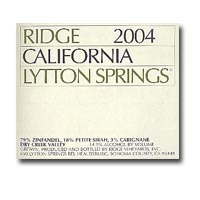 Ridge
RidgeLytton Springs 2004
Sonoma County, California
Rating: 8.5
I'll start off by proclaiming how awesome my mom is. Aside from birthing me she also, upon being invited to my apartment for her birthday dinner, volunteered to cook (and set up a tiny Christmas tree which I would have never thought to procure on my own). Don't get me wrong, I love cooking and would have gladly made dinner. However, I couldn't turn down one of Gail's signature dishes: fettucini with shrimp, tomatoes, sundried tomatoes, basil, shallots, and feta. This left my boyfriend and I to choose an appropriate vino, bread, hors d'orderves, and dessert. The wine proved to be easy, as we went with our gut instincts. Getting out of Zingerman's in a timely manner, however, is a bitch. We were like Hansel and Gretel, sampling goodies fed to us by a staff hellbent on fattening us up and, through a natural curing process, making us delectible enough to be sliced and placed between two slices of Farmhouse bread , priced $13 at the Roadhouse.
While the pasta was being prepared, we snacked on two cheeses: a locally made goat cheese rolled in tarragon and a creamy, brie-like cheese from Burgandy which is actually rubbed in pulp from Burgandy grapes. A no-brainer match was L. Mawby's Blanc de Blanc, a crisp, dry, delicious sparkler from the Leelanau Peninsula. Probably best known for his Sex Brut Rose (and subsequently one of the most predictible double entendres in the local wine industry), Lawrence Mawby's winery is my favorite in Michigan. All sparkling but all over the place and a great tasting room experience to boot. But the bubbles were just the beginning...
Although we had considered going with the Geyserville, we chose the Lytton Springs for its higher concentration of Petite Sirah. All Ridge proprietary Zinfandel blends possess a common thread in taste, but are different just enough to warrant indecision of what to drink with a particular meal. Initial instincts, as often the case, proved correct. The 2004 Lytton Springs, which is 79% Zinfandel, 18% Petite Sirah, and 3% Carignane, was the right choice. Rich plum color with a nose of dark berry and smoke, but also walnut and fortified grape(which I'll get to later). This is a serious Zin- all the fruit-forward qualities for which the varietel is known, but with added structure and boldly finessed tannins. It's also a formidible match to a dish with shellfish and tomatoes, as it's smooth enough not to drown out the flavor of the former and hearty enough to stand up to the ripeness and acidity of the latter.
Lytton Springs is Bryan Ferry- unquestionably masculine, but wrapped in such a suave and deboniare package. Perhaps I should have put on Country Life as we sat around the table after dinner, savoring the last of the wine. This is when an important discovery was made- the more the Lytton Springs opened up, the more it took on an aroma of vanilla, nuts and cognac quite reminiscent of the wine that, coincidently, we planned on drinking with dessert. Chateau d'Orignac Pineau des Charentes, one of my favorite dessert wines, is aged in cognac barrels and has a toasty hazelnut flavor. With its sonically harmonious fusion of strong flavors, it just might be the Bryan Eno of wine. Or not. Trying the two side by side only made the similarities more apparent and made for a seamless transition from dinner to dessert. Naturally, both go well with chocolate-frosted cupcakes.
-Lauren
Subscribe to:
Posts (Atom)